
Choosing a home often comes down to two fundamentally different approaches. A custom home designed around how you live, or a mass-produced home built to meet market demand. While both options provide shelter, their long-term value differs in measurable and practical ways.
The distinction shows up over time. It appears in maintenance costs, energy performance, adaptability, and how well a home continues to support daily life as needs change. Understanding these differences helps homeowners evaluate value beyond the initial price tag.
At AV Architects + Builders, decades of experience working with homeowners reveal a clear pattern. Homes planned with intention age differently than homes built for speed. The gap between the two widens as years pass.
This article explains how custom and mass-produced homes differ, where real value is created, and what factors matter most when planning for the long term.
What Is a Custom Home
A custom home is designed and built for a single homeowner on a specific site. Layout, structure, systems, and materials respond to lifestyle needs, climate conditions, and long-term priorities rather than a fixed template.
This process begins with planning and collaboration. Architects and builders work together to align design, engineering, and construction from the start. A clear overview of what a custom home is helps clarify how this approach differs from standard construction.
Unlike production homes, customization allows flexibility in everything from room dimensions to mechanical systems. This flexibility supports efficiency, durability, and comfort over time.
The Benefits of a Custom Home
Custom homes provide control over where investment dollars go. Homeowners decide whether to prioritize energy systems, structural integrity, indoor air quality, or long-term maintenance reduction.
This approach supports advanced strategies such as geothermal energy for residential use and carefully designed airflow through passive ventilation strategies. These systems improve comfort while lowering operating costs when integrated early.
Customization also allows thoughtful material selection and construction sequencing. Many of the long-term benefits of building a custom home stem from these early decisions rather than decorative finishes.
What Is a Mass-Produced Home
Mass-produced homes follow standardized plans used repeatedly across developments. Builders focus on efficiency, speed, and cost control by limiting variation in layout and materials.
These homes meet building code requirements but rarely exceed them. Design choices favor broad appeal over individual use. Over time, homeowners may encounter limitations related to storage, circulation, system capacity, or material durability.
Many of the drawbacks associated with mass-produced homes originate from this volume-driven model.
The Value of Choice
Initial price does not represent total cost. Production homes often require upgrades, modifications, or early repairs that increase overall spending. Buyers frequently encounter hidden costs in new construction after move-in.
Custom homes require more planning upfront but reduce downstream expenses. Decisions are made once, intentionally, with fewer compromises later. Value accumulates through consistency in performance rather than repeated fixes.
For homeowners comparing flexibility levels, understanding the difference between custom homes and semi-custom homes provides useful context.
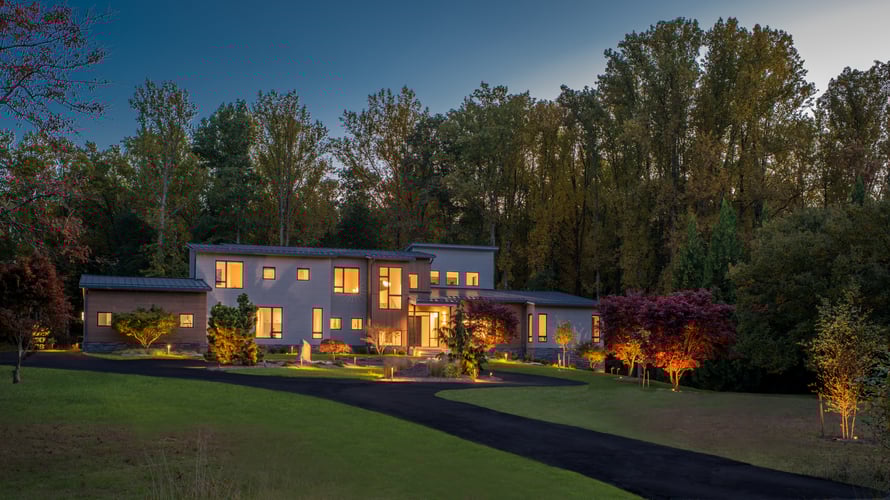
 The Woodlands House, Great Falls, Virginia, AV Architects + Builders
Real Talk About Long-Term Performance
Marketing materials rarely address how homes perform after years of use. Production homes often rely on thinner insulation, standardized HVAC sizing, and materials selected for speed. These choices affect comfort and energy use.
Custom homes prioritize performance metrics. Proper insulation planning, orientation, and system coordination support consistent indoor conditions. Experienced teams also apply strategies that save time during custom home construction without sacrificing build quality.
Exterior planning matters as well. Custom home landscaping and sustainable home design principles contribute to temperature regulation, drainage control, and reduced energy demand.
The Experience of Living in the Home
Homes designed around their occupants function differently. Storage aligns with daily routines. Natural light supports activity patterns. Circulation flows logically from space to space.
This difference reflects the art of custom homes compared to mass production. Design decisions focus on usability and longevity rather than resale staging.
So, What’s the Real Value
Real value comes from alignment between design and use. A home that matches how people live performs better, costs less to maintain, and adapts as needs change.
Mass-produced homes offer speed and predictability. Custom homes offer control, durability, and long-term efficiency. Each serves a purpose, but only one is built to evolve with its occupants.
A home designed with intention becomes a long-term asset rather than a short-term solution.
Before You Decide
Understanding construction categories clarifies expectations. The National Association of Home Builders outlines them types of custom home construction and how they differ from other building models.
Seeing a completed project also adds clarity. A visit to a finished custom home shows how planning, materials, and systems work together in real conditions.
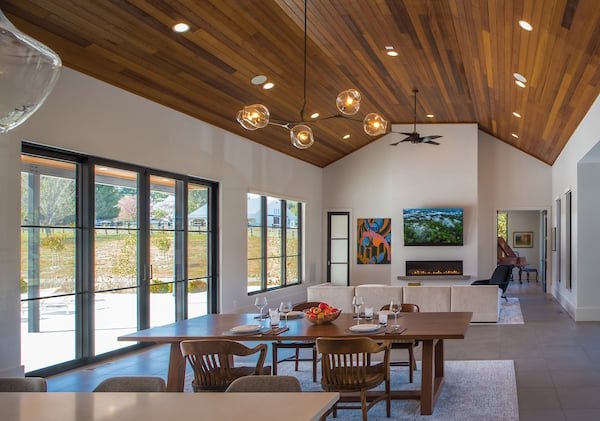 The Vista House, Great Falls, Virginia, AV Architects + Builders, Photography by Maxwell Mackenzie
Where It All Comes Together
The choice between a custom home and a mass-produced home reflects priorities around comfort, performance, and long-term value.
If you want to explore what intentional home planning looks like, you can start by scheduling a conversation through our contact page. Additional resources and educational guides are available in our Learning Center.